
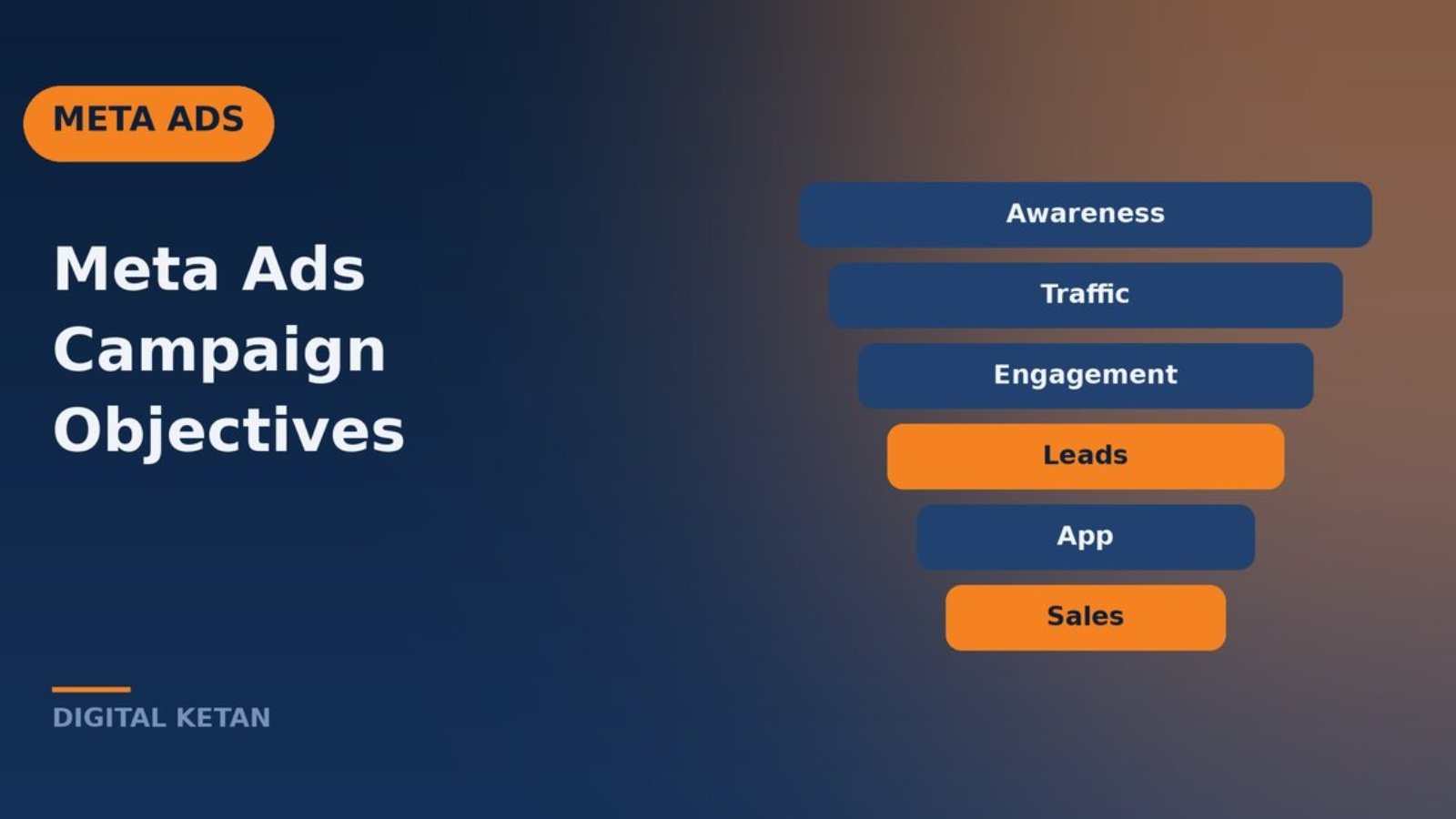
Meta Ads campaign objectives tell Meta what result you want from a campaign, and the delivery system then shows your ads to the people most likely to take that action. There are six objectives: Awareness, Traffic, Engagement, Leads, App promotion and Sales. Choosing the right one matters because Meta optimizes hard for exactly what you ask for. If you want customers but choose Traffic, you will get clicks from people who are likely to click, not necessarily people who are likely to buy. As a rule, pick the objective closest to the business result you actually want, and make sure you can measure that result.
This guide is for business owners and marketers running Facebook and Instagram ads who want to choose objectives with confidence. I will explain how objectives work, what each one is for, how performance goals and conversion locations fit in, how to choose for your situation, common mistakes, a practical example and a checklist. If you are new to the platform, read my Meta Ads guide first for the fundamentals.
How Campaign Objectives Work
A Meta Ads campaign has three levels. The campaign level holds the objective. The ad set level holds the audience, placements, budget and schedule when not set at campaign level, the conversion location and the performance goal. The ad level holds the creative, copy and destination.
The objective is the first decision and it cannot be changed after the campaign is published. It shapes which conversion locations and performance goals are available below it. When a campaign runs, Meta’s delivery system enters auctions on your behalf and estimates how likely each person is to take the action you are optimizing for. It then favors people with a higher estimated likelihood. That is why the objective, together with the performance goal, is such a powerful setting: it decides who sees your ads.
Meta simplified its objectives some years ago into the six outcome based objectives used today. Older names such as Reach, Video views, Conversions and Catalog sales still exist as options inside the new objectives, usually as performance goals or campaign settings, rather than as separate objectives.
The Six Meta Ads Objectives
Awareness
Awareness campaigns aim to show your ads to as many relevant people as possible, or to people most likely to remember them. Performance goals include maximizing reach, maximizing impressions and maximizing ad recall lift. Video views can also be optimized within Awareness.
Use Awareness when your goal is genuinely to be seen: launching a new business in a local area, supporting an event, building familiarity before a promotion, or keeping a brand visible alongside other activity. Do not expect it to produce sales efficiently on its own, because it is not optimizing for action.
Traffic
Traffic campaigns send people to a destination such as a website, an app, a Messenger or WhatsApp conversation, or a call. Performance goals include maximizing link clicks and landing page views. Landing page views is usually the better choice for websites, because it optimizes for people who actually wait for the page to load rather than people who click and leave.
Traffic is useful for content distribution, building website audiences for retargeting, or when you cannot yet track conversions. Its limitation is that Meta finds people who click, and people who click a lot are not always people who buy.
Engagement
Engagement campaigns aim for interactions: post engagement, video views, Page likes, event responses, messages and certain on website actions. Use Engagement when interaction itself is the goal, such as building social proof on a key post, driving event responses or starting message conversations. For businesses that sell through conversations, the messaging options within Engagement or Leads can work well.
Leads
Leads campaigns collect contact details or start conversations with potential customers. Conversion locations include instant forms on Facebook and Instagram, your website, Messenger, Instagram and WhatsApp conversations, calls, and app. Performance goals can include maximizing the number of leads, maximizing conversion leads, which optimizes for leads that become qualified or converted based on data you send back, and maximizing website conversions.
Leads is the main objective for service businesses, B2B companies and anyone who sells after a conversation. It is covered in detail in its own guide later in this series, but the key point is that lead volume and lead quality often pull in different directions, so choose conversion locations and form settings deliberately.
App promotion
App promotion campaigns drive app installs and actions within an app. They require your app to be set up with Meta’s SDK or a supported mobile measurement partner. If you do not have an app, you will not use this objective.
Sales
Sales campaigns find people likely to purchase or take other valuable actions on your website, in your app or through messaging. Performance goals include maximizing the number of conversions and maximizing the value of conversions. Sales campaigns can also use a product catalog for dynamic ads that show relevant products to each person.
Sales depends on accurate tracking. You need the Meta Pixel, ideally combined with the Conversions API, sending purchase or other key events with values. If tracking is weak, Sales campaigns have little to learn from.
Objectives, Conversion Locations and Performance Goals
The objective alone is not the whole story. At the ad set level, two further choices shape delivery.
The conversion location is where you want the result to happen: website, app, messaging apps, instant forms, calls or combinations. The performance goal is the specific result Meta optimizes for within that location, such as landing page views, leads, conversions or conversion value. For website conversions, you also choose the specific event, such as Purchase, Lead or Complete Registration.
These choices need to match your measurement. If you optimize for a website Lead event, that event must fire reliably on your site. If you optimize for conversion value, purchases must send values. This is the same principle that applies to Google Ads; my guide to Google Ads conversion tracking covers why the event you optimize toward matters so much, and the ideas carry over to Meta.
How Meta’s Learning Phase Affects Your Choice
Each ad set goes through a learning phase when it starts or after significant edits. During this time, delivery is less stable while the system explores who responds. Meta’s guidance is that an ad set generally needs around 50 optimization events within a week after its last significant edit to exit the learning phase.
This has a direct effect on objective choice. If you optimize for purchases but only get a handful each week, the ad set may stay in learning with unstable results. Some advertisers then move one step up the funnel, for example optimizing for Add to Cart or Initiate Checkout, to give the system more events to learn from. That can help, but it also changes who Meta looks for. The ideal is to optimize for the deepest event you can reach with enough volume, and to consolidate ad sets so each gets more data rather than splitting budget thinly.
How to Choose the Right Objective
Start from the business result and work backward:
- What result actually makes money? A purchase, a qualified lead, a booked call, a store visit or an app subscription.
- Can you measure that result? If yes, choose the objective and performance goal that optimize directly for it. If not, fix measurement first or choose the closest measurable step.
- Do you have enough volume? If the deepest event is too rare for the learning phase, consider a slightly higher funnel event or consolidating campaigns.
- What is the role of this campaign? A retargeting campaign, a prospecting campaign and a local awareness campaign may reasonably use different objectives.
A simple mapping for common goals:
- Online store selling products: Sales, optimizing for purchases or purchase value.
- Service business wanting enquiries: Leads, using instant forms or website leads depending on quality needs.
- B2B company wanting qualified demos: Leads, ideally with conversion leads or website events, plus CRM feedback.
- Local business launching in a new area: Awareness for reach, combined with Leads or Sales for response.
- Publisher or content creator: Traffic, optimizing for landing page views.
- Business selling through chat: Leads or Engagement with a messaging conversion location.
- Mobile app: App promotion.
Structuring Campaigns Around Objectives
Once objectives are chosen, the next question is how many campaigns to run and how they relate. A simple, effective structure for many businesses has two layers.
The first layer is prospecting: reaching people who do not yet know you. This campaign usually uses the Sales or Leads objective with broad targeting, letting Meta find likely customers based on your conversion data. Creative here needs to introduce the business, the problem it solves and the offer.
The second layer is retargeting: reaching people who have already visited your website, engaged with your content or started but not completed an action. It usually uses the same objective as prospecting, because the goal is still a sale or lead, but the creative can be more direct, answering objections and reminding people of the offer.
Some advertisers now combine these into a single campaign and let automation decide how much to spend on existing versus new audiences. Either approach can work. What matters is that each campaign has a clear job, enough budget to learn and a measurable result.
Budget Settings and Objectives
Budgets can be set at the ad set level or at the campaign level. Campaign level budgeting, called Advantage campaign budget, lets Meta distribute budget across ad sets based on where it expects the best results for your objective. This usually works well when ad sets share the same objective and optimization event and differ mainly in audience or creative. Ad set budgets give more manual control, which can be useful when you need guaranteed spend on a particular audience, such as a small retargeting group.
Whichever you choose, budget should be large enough relative to your cost per result for the ad set to gather a meaningful number of optimization events each week. A tiny budget spread across many ad sets rarely produces stable results.
Meta Objectives Compared With Google Ads
Meta and Google approach demand differently. Google Search captures people already searching for a solution, while Meta shows ads to people based on predicted interest and behavior, often before they are actively looking. Campaign objectives on Meta play a similar role to the goals and bidding strategies you choose in Google Ads. If you run both platforms, my overview of Google Ads campaign types helps map one to the other. Meta’s Advantage+ sales campaigns share some ideas with Performance Max: broad automation, strong reliance on conversion data and creative as a key lever.
For many businesses, the right answer is not one platform or the other but a sensible mix. My Google Ads guide and the channel comparison in SEO vs Google Ads help frame how paid social fits alongside search.
Common Mistakes When Choosing Objectives
- Choosing Traffic when you want sales. Traffic finds clickers. If you want buyers and can track purchases, use Sales.
- Choosing Engagement to “warm up” an audience that you then expect to buy. Engagement finds people who like, comment and share. They are not necessarily buyers.
- Optimizing for an event that is not tracked correctly. If the Lead event fires on page load instead of form submission, Meta will optimize toward page visitors.
- Splitting budget across too many ad sets. Each ad set needs enough events to learn. Fragmentation keeps campaigns in learning.
- Judging Awareness by cost per lead. Evaluate each campaign on the job it was given.
- Using instant forms without quality controls. Easy forms can bring many low intent leads. Use higher intent form settings or qualifying questions when quality matters.
- Making frequent significant edits. Each significant edit can restart learning.
Landing Pages and Destinations Still Matter
Whatever objective you choose, the destination affects results. People arriving from Meta are often on mobile and were not necessarily searching, so pages need to load quickly, explain the offer immediately and make the next step easy. Speed problems cost conversions on every channel; my Core Web Vitals guide explains how to measure and improve them. For local businesses, consistent location information and reviews help too, as covered in my local SEO guide.
Objectives for Different Business Types
Local service businesses
Local businesses usually want calls, bookings or enquiries. Leads campaigns with instant forms or calls work well when combined with qualifying questions. Awareness can support a new location or seasonal push. Keep audiences within a realistic service radius.
Ecommerce
Ecommerce businesses usually benefit most from Sales campaigns with a catalog and value optimization, supported by retargeting of site visitors and cart abandoners. Reliable Pixel and Conversions API tracking is essential.
B2B
B2B buyers take longer to decide and often involve several people. Leads campaigns with strong qualifying questions, website lead events and CRM feedback help Meta learn which leads matter. Content distribution through Traffic can support longer sales cycles, and the patterns I describe from working on B2B websites apply here too: clear positioning and credible proof matter more than volume.
Practical Example: A Local Fitness Studio
This is an illustrative example to show the process, not a real client case.
Imagine a fitness studio that has been running Engagement campaigns to boost popular posts. The posts gather likes and comments, but very few people book a trial class. The owner wants more trial bookings from people who live nearby.
The first step is measurement. The studio’s booking page is set up so that a Lead event fires only when a trial booking is confirmed. The Pixel is installed and the Conversions API is connected through the booking platform integration.
Next, the studio creates a Leads campaign with a website conversion location, optimizing for the confirmed booking event. Audiences are kept within a realistic travel distance. Creative shows real classes, the trial offer and what to expect on the first visit. A smaller Awareness campaign runs around the opening of a new class type, judged on reach in the local area rather than on bookings.
Because bookings may not reach 50 per week at first, the studio uses one ad set rather than several, so all conversions help the same ad set learn. After several weeks, the owner judges the Leads campaign on cost per confirmed trial and on how many trials become memberships. The point of the example is aligning the objective with the real business goal and making sure it can be measured.
Meta Ads Objective Checklist
- The business result the campaign should drive is written down.
- The chosen objective is the closest match to that result.
- The conversion location and performance goal match how the result happens.
- The event you optimize for is tracked accurately with the Pixel and Conversions API.
- Expected weekly event volume is enough for the learning phase, or ad sets are consolidated.
- Each campaign is judged on the job it was given.
- Landing pages or forms are fast, clear and mobile friendly.
- Lead forms include qualifying questions when quality matters.
- Significant edits are planned and limited during learning.
- Results are compared with real sales or qualified leads, not just platform numbers.
Frequently Asked Questions
Which Meta Ads objective is best?
The best objective is the one closest to the business result you want and can measure. For most businesses that means Sales for online purchases or Leads for enquiries, rather than Traffic or Engagement.
Can I change the objective after launching a campaign?
No. The objective cannot be changed once a campaign is published. To change it, create a new campaign, which you can do by duplicating the existing one and choosing a new objective.
Is Traffic a good objective for sales?
Usually not. Traffic optimizes for clicks or landing page views, not purchases. If you can track purchases, a Sales campaign will generally find more buyers.
What is the learning phase?
It is the period after launch or a significant edit when Meta explores who responds to your ads. Meta generally suggests about 50 optimization events in a week for an ad set to exit learning.
Should I use instant forms or website leads?
Instant forms often produce more leads at lower cost but can reduce quality. Website leads usually bring higher intent. Test both, and judge them on qualified leads rather than raw volume.
Do I need the Meta Pixel for every objective?
Awareness and some Engagement goals can run without it, but Sales and website Leads depend on accurate tracking. Installing the Pixel with the Conversions API is recommended for almost every business.
How many campaigns should a small business run?
Often just one or two. Fewer, well funded campaigns give each ad set more data and help it exit the learning phase faster than many small campaigns.
Conclusion
Meta Ads objectives are instructions to a powerful optimization system. Choose Awareness when being seen is the goal, Traffic when visits are the goal, Engagement when interaction is the goal, Leads when enquiries are the goal, App promotion for apps, and Sales when purchases are the goal. Then set conversion locations and performance goals that match, track the result accurately, and give each ad set enough volume to learn.
Most wasted Meta budget comes from asking the system for the wrong thing. Aligning objectives with real business outcomes is one of the simplest and most effective improvements you can make. For how paid social fits into your wider plan, see my guide to digital marketing strategy for small businesses.
Want Your Meta Ads Optimizing for the Right Results?
If your Facebook and Instagram ads bring likes, clicks or cheap leads but not customers, I can review your objectives, tracking and campaign structure and rebuild them around the results that matter to your business. Contact me through DigitalKetan.com to discuss your Meta Ads.